Crystal Magazine Jun 04, 2026
Rabee Al-Akhras: Art Is Not a Profession, It Is a Living Presence
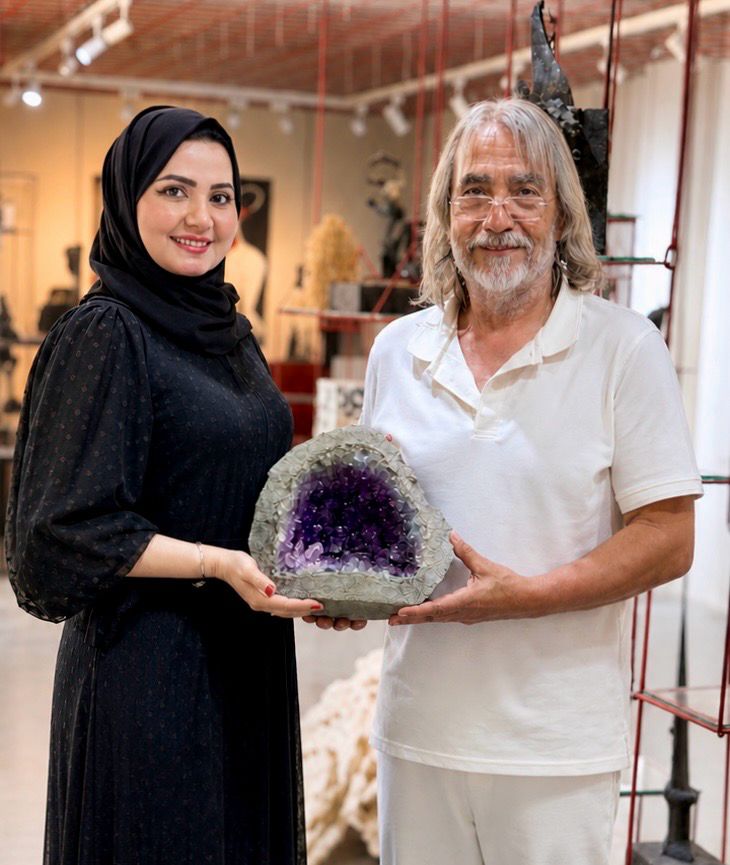
An Exclusive Interview by Dr. Maha Gamal El-Din
In the artistic journey of Rabee Al-Akhras, art does not appear as a mere visual practice, but rather as a long voyage of inner discovery and deep listening to everything that accumulates within the soul over time. He does not believe in ready-made formulas, nor in repeating a style simply to create a recognizable signature. For him, the artist is a constantly evolving being, and every new work must carry the traces of that evolution.
In this exclusive conversation with Crystal Magazine, Rabee Al-Akhras speaks about passion, fear, unfinished works, and the inner child he refuses to let die. He also reveals his personal vision of artistic identity and his relationship with memory and time.
How do you see the relationship between your artworks and your personal memory?
I believe every artist carries within them a vast archive that begins in childhood. Sometimes, a work awakens a very old memory, but it never returns exactly as it once was. Time passes over it, covering it with layers of experience, emotions, and personal growth.
What eventually emerges is not a simple recollection of the past, but rather a rebirth of it, blended with everything we have lived through since.
Do you believe in the idea of “chance” in art?
I do not like to describe it as chance.
I see it as a form of revelation.
Artists store countless things within themselves without realizing it, and then, at a certain moment, those hidden elements emerge, transformed into something entirely different from their original form.
That is why I believe an artwork is never born suddenly. It emerges from a long and invisible accumulation of experiences.
Have you ever started works that you were unable to complete?
Many times.
Some works exhausted me emotionally before they were finished. Others made me feel that the idea behind them had not yet matured. Whenever I reach that feeling, I prefer to stop.
And what do you do with those unfinished works?
I remove them from my sight.
Their constant presence tends to pull me backward, as if they are a permanent reminder of something that failed to reach its proper form. I do not like remaining attached to what was not meant to be born yet.
Perhaps the idea will return later in a more mature shape, but artists should not become prisoners of everything they once began.
How do you balance your artistic identity with market demands?
To be honest, I do not think much in terms of “artistic identity” as it is commonly understood.
I do not like repeating myself merely so people can instantly recognize my work. Repetition can sometimes become a form of stagnation.
I am not the same person today that I was yesterday, and it is only natural for that transformation to be reflected in my work as well.
Yet many believe that a strong visual identity is essential for an artist.
If identity means spirit, then I fully agree.
But if it simply means a repeated shape or a fixed symbol inserted into every artwork, then I do not believe in that kind of identity.
An artist’s true essence reveals itself through the entirety of their journey, not through the repetition of a single visual element.
Do you fear losing your passion?
Absolutely.
I believe the most dangerous thing an artist can lose is their original sense of wonder. That is why I constantly try to protect the child within me.
The child is the source of curiosity, playfulness, amazement, and the desire to experiment. When that child dies, art becomes nothing more than a cold profession.
If you could go back in time, what advice would you give your younger self?
Perhaps I would pay more attention to the financial side of life.
I have never been a materialistic person, and maybe if I had focused on that aspect earlier, my situation today would be different. Yet at the same time, I am grateful that money never corrupted my relationship with art.
And the most important advice would simply be:
“Just be yourself.”
If art had not chosen you, what other dream might have shaped your life?
There was an old place I owned in Damascus, and I dreamed of transforming it into a creative space where artists could gather, experiment, exchange ideas, and create together.
I imagined it as more than just a venue. It would have been a living environment for dialogue, artistic exploration, and shared inspiration.
But life has its own ways of reshaping dreams, especially when cities endure the hardships of war.
Some dreams change their form over time. Yet perhaps, in one way or another, they never truly disappear.
Finally, how does Rabee Al-Akhras define himself?
I am not sure an artist should define themselves at all.
What I do know is that I dislike masks, and I dislike becoming a fixed version of myself simply to satisfy other people’s expectations.
I am simply trying to remain honest with the present moment… and with the child who still lives inside me.